


“Orange is red brought nearer to humanity by yellow.” – Wassily Kandinsky
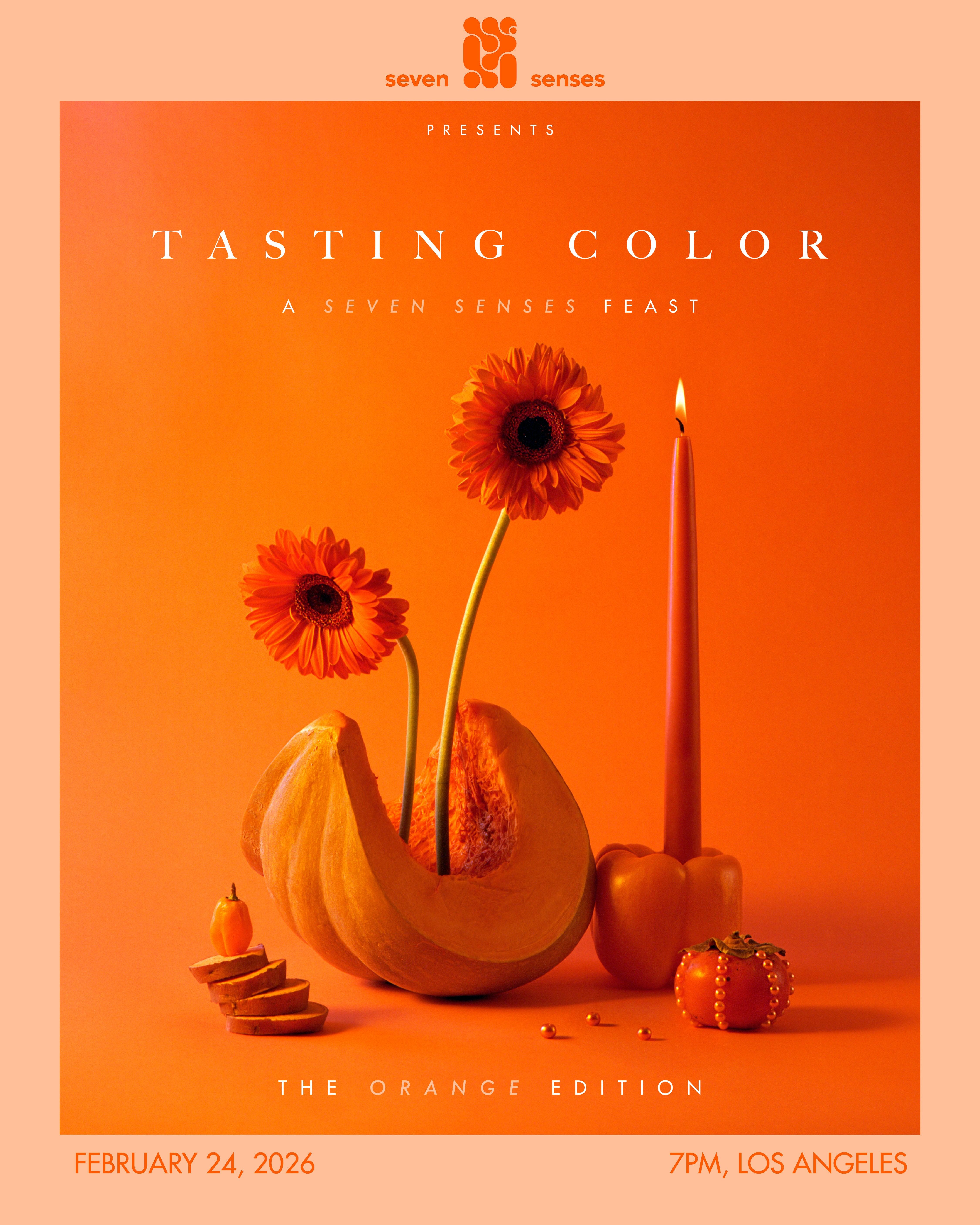
I’m happy to announce that I’m curating the next TASTING COLOR: a Seven Senses Feast. This time we’ll be exploring the color ORANGE.
This is the third edition of this on-going series. The first iteration was dedicated to Green and the second one was Indigo.
As some of you know, this sensorial dinner series was born out of this newsletter. It originated from my color issue, featuring a photography series by Sophie Calle titled ‘The Chromatic Diet,’ which was inspired by a fictional character in Paul Auster’s novel ‘Leviathan,’ who ate a different color-themed meal every day of the week.
A work of literature turned into a photo series, which has now become a real life experience.
We’ll be eating a delightfulorange meal (prepared by Chef Tracy Tober), dining on orange ceramics (created locally by BAUER Pottery), listening to an orange soundscape, wearing orange fabrics, and enjoying the scent of a flower and citrus installation.
The sensory dinner will be hosted in Los Angeles on FEBRUARY 24, 2026 and you can make a reservation online. Discounts are available to Seven Senses annual paid members and attendees to previous dinners (email me for code).

Anytime I curate a TASTING COLOR dinner, it’s an invitation for me to immerse myself in the chosen color. Orange is my favorite hue, so I was excited to learn more about the influence of this bright zesty color on culture. Here are some highlights:
Before the 15th century, the colour orange did not have a name in Europe; it was simply called yellow-red.
Portuguese merchants brought the first orange trees to Europe from Asia in the late 15th and early 16th century, along with the Sanskrit word “naranga” — which became ‘naranja’ in Spanish and ‘laranja’ in Portuguese.
In Ancient Egyptian tomb paintings, orange was often a central color. It was painted using realgar— a pigment made from soft minerals typically found in crystals – which was also used by medieval artists to color manuscripts.
In certain religions, such as Buddhism and Hinduism, orange represents the highest state of enlightenment and spiritual knowledge.
For visibility purposes, astronauts wear orange suits during takeoffs and reentries into the atmosphere.
Orange has more recently become a symbol of human rights; there are a number of organisations around the world who use the colour to represent a call for peace and change.
To celebrate, I wanted to dedicate this issue to ORANGE. Since the color got its name from the fruit, it’s impossible to separate the two, so below you’ll find inspiration that blends citrus and color through all the senses — SEE, HEAR, SMELL, TASTE, TOUCH, BALANCE, and ENVISION.
In Joy,
Sabrina

SEE
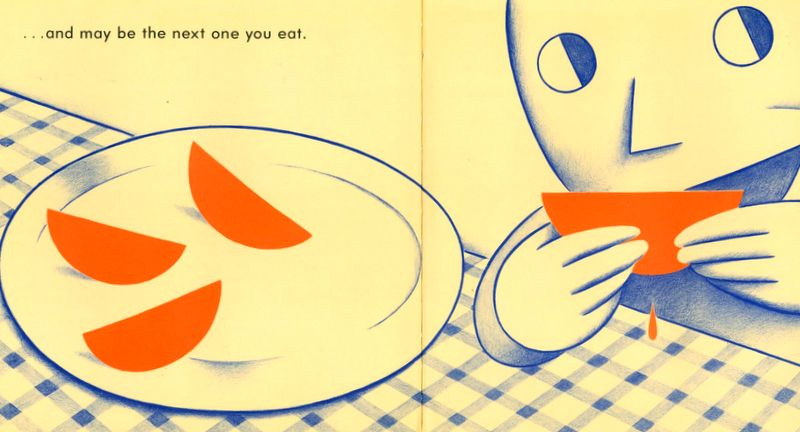
The Orange Book | children’s book by Richard McGuire (1992)
Available online
I was so charmed in discovering this vintage children’s picture book by Richard McGuire. The story follows the life path of 14 oranges from a single tree as they go their separate ways, landing in art school, a vaudeville act, and a TV studio. The book explores themes of chance and destiny through witty and unexpected scenarios.

HEAR
Ecstatic Orange | music composition by Michael Torke (1985)
Listen on Youtube
In the mid 1980’s, Michael Torke was studying musical composition in Yale University and decided to start an early series of compositions “to celebrate without modulation a single color”.
Relying on his synesthesia, he created five colors-inspired compositions for orchestra.
For orange, the tonal center of the music gravitates towards a six note melody, with two flutes, two oboes, two clarinets, two bassoons, four horns, a trumpet, two trumpets, three trombones, a tuba, a piano, four timpani, a whole set of strings and a large percussion section.
Along with the music, color headings appear in the score, entitled “Absinthe”, “Apricot, “Terra Cotta”, “Unripe Pumpkin”, “Copper”, etc – which refer to the different shades of orange experienced by the composer.
The ‘Ecstic Orange’ score premiered on May 16, 1985 with the Brooklyn Philharmonic under the baton of Lukas Foss at Copper Union in New York City.

SMELL
Hybrid Citrus Scent
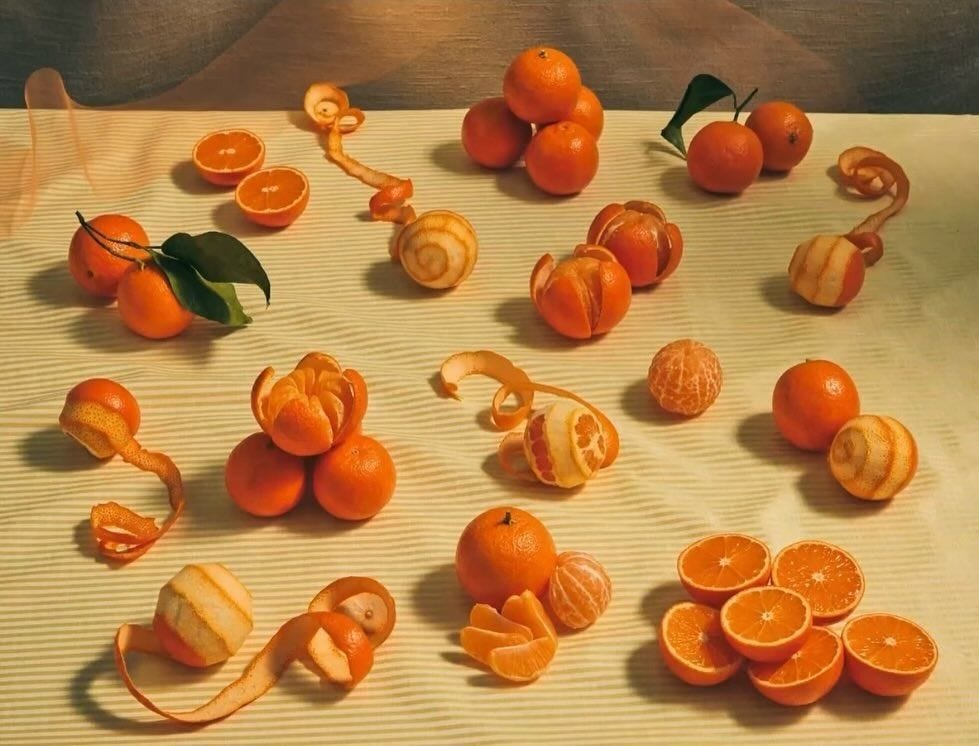
Different plants create various odor molecules, and as a result, they all have a distinct smell. When it comes to citrus, their scent comes from mixing the four naturally-occurring citrus fruits: pomelos, true mandarins, lemons, and small-flowered papedas.
For generations, farmers have hybridized these species to generate hundreds of new variants that combine the characteristics of the four ancestral citrus fruits. The cross between a pomelo and a mandarin, for example, results in a sweet orange, and if a sweet orange is crossed again with a pomelo, the result is a grapefruit.
As the plants are hybridized, their enzymes can be combined in novel ways which changes their odor molecules. The scents of various citrus fruit varieties differ as a result of the recombination of odor synthesis pathways.

TASTE
Turning Orange: the Carrot Transformation
According to the World Carrot Museum, carrots were grown in the Afghanistan region 5,000 years ago, and they were mostly white and purple in color. Egyptian temple drawings from 2,000 BC depict purple plants, which Egyptologists believe to be purple carrots.
The first orange carrots showed up in artwork in Italy and Spain in the early 1500s, and it started gaining popularity in the Netherlands in the 16th century.
Legend has it that Dutch growers cultivated orange carrots as a tribute to William of Orange, who led the Dutch in the fight for independence from Spain. But it’s more likely that Dutch growers cultivated the orange carrot through selective breeding as a sweeter and less bitter variety.

TOUCH
Mr. Birch: the Champion Orange Peeler
In 1899, The Strand Magazine, a British monthly, introduced its readers to Birch as “the one man we would wish to have as a companion on a desert island of the Pacific.”
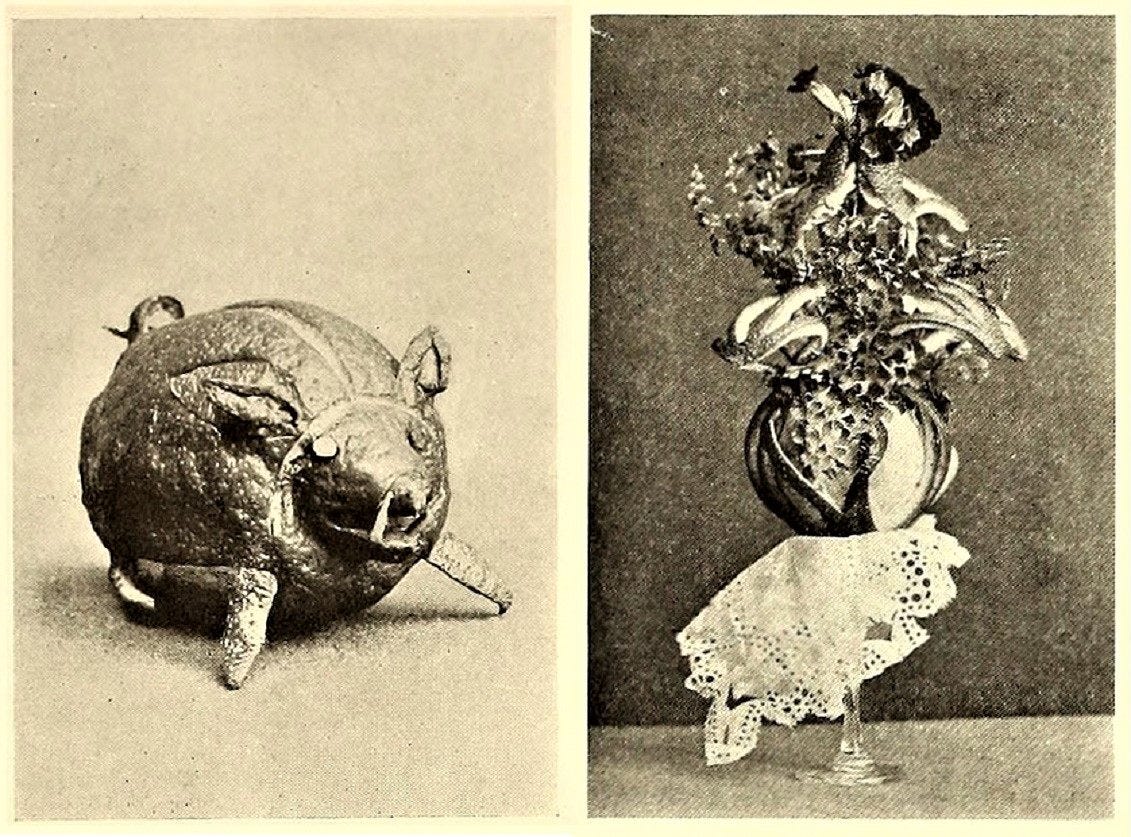
In a photo portrait of Birch, he’s wearing an apron and holds a partially peeled orange in his hands. According to the article, Birch was a tinkerer and inventor who could make utensils from various materials (including coconuts).
On his voyages around the world, Birch happened to be holed up with thousands upon thousands of cases of oranges. At the time, the citrus industry was booming and worldwide trade in oranges was growing. Birch took the opportunity to apply his artistry and industry to his juicy traveling companions.
He developed a technique of quartering the peel and then slicing each quarter into a series of attached, ribbon-like strips. Loosened in this way, the fruit’s outer protection could be crafted into all manner of designs.
Birch wove the rinds into abstract, flower-like decorations. He created a Cubist-like face, a cute little boar, a Japanese houseboat and a British crown in delicate detail, amongst many others.

BALANCE
Oranges: poems by Frank O’Hara and paintings by Grace Hartigan
In the 1950’s, Frank O’Hara visited the studio of his friend, the painter Michael Goldberg, and wrote the poem ‘Why I am not a Painter’:
One day I am thinking of
a color: orange. I write a line
about orange. Pretty soon it is a
whole page of words, not lines.
Then another page. There should be
so much more, not of orange, of
words, of how terrible orange is
and life.
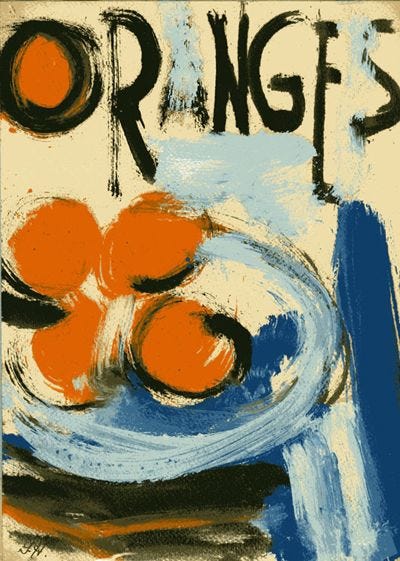
From that poem, a suite of others emerged titled ‘Oranges’, with no mention of the colour itself. It inspired his painter Grace Hartigan to make 12 paintings illustrating O’Hara’s ‘Oranges’ and incorporating its text. In her paintings, the colour becomes an introspection: an open window into the self and how our actions relate to our identity.

ENVISION
The Orange Show Monument | Folk Art by Jeff McKissack
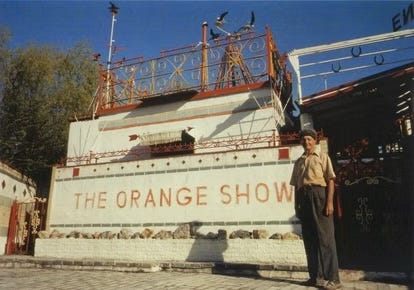
Jeff McKissack was a retired mail carrier and outsider artist who transformed a small suburban lot near his house into a folk art installation. He named it “The Orange Show” in honor of his favorite fruit and as a symbol of a long, healthy life.
Built between 1956 and 1979 outside of Houston, the 3,000 square foot labyrinthine space is composed of materials McKissack collected on the roadside and in antique shops: tiles, ornamental fencing, garden statuary, tractor seats metal buggy wheels (which mimic the appearance of the segmented orange). Each piece was hand-painted and placed by McKissack.
In 1979, he opened it to the public and it has since been listed on the National Register of Historic Places. The park offers various public programming, including workshops, music, storytelling and performance.

my favourite colour 🧡
Love this edition and wish I lived closer to come to the dinner! This also made me think of Ada Limon’s poem Oranges & The Ocean