

Call Me Crazy
On mental illness, creative genius, and the thin line between the two.

It’s a Full Moon, my monthly deep dive on a theme along with 7 sensory recommendations to further explore that topic. If you rather listen to the essay, an audio recording is included up top.

All my friends are becoming therapists.
They had other careers before that: one of them worked in wellness tech (which it turns out makes you very unwell), another was in the music industry (a field that’s almost guaranteed to give you a mental breakdown), and one is an artist (fulfilled creatively but stressed financially).
They came from various backgrounds but somehow all found themselves drawn to psychotherapy. And each one of them loves what they do: they feel engaged, fulfilled, and challenged in interesting ways.
I thought this professional reconversion was specific to my social circle: they’re people who are empathetic, good listeners, and sensitive to other people’s needs. But it turns out that it’s a more general trend – so much so that last month The New Yorker published a humorous article titled ‘What I Know About You Based on How Many of Your Friends Are Becoming Therapists.’
I can’t tell if this is a sign of people’s mental health getting worse, or if the stigma around getting support is finally being lifted. Probably both.
“The opposite of depression is expression because what comes out of our body doesn't make us ill, what stays in there does.” – Dr. Edith Eger
Some mental illnesses are linked to genetics, and others are circumstantial – often a mix of the two. But mental illness rarely lives in a silo. We tend to put the emphasis and the responsibility on individuals to heal themselves from their past traumas, but rarely do we shine a light on the larger societal issues that feed those conditions. Hypercapitalism, colonization, political marginalization, institutional racism and homophobia, and countless other issues play a crucial role in mental illness.
I remember a few years ago, my acupuncturist told me something that stayed with me ever since: “We are symptoms of a sick society.”
Indeed we are. But society would rather point the finger at the person, not realizing that three fingers are pointing back at it. It’s easier to blame someone for their addiction than to hold accountable the pharmaceutical companies profiting from it. The case of Purdue Pharma and the Sackler family — who aggressively marketed OxyContin while suppressing evidence of its addictive nature — is one of the most devastating examples of this mechanism. When corporate lobbies are in charge of health and ethical decisions, our mental (and physical) wellbeing is bound to suffer.
“The therapist who is really interested in helping the individual is forced into social criticism.” — Alan Watts
Nothing is black and white, and I don’t believe that “all pharma is evil.” Medicine saves lives, and it also saves minds. Many people I love have suffered from various forms of mental illness – from anxiety to depression, from bipolar disorder to OCD, from addiction to schizophrenia. For some, medicine has enabled them to remain on this earthly plane when they were in the depths of despair. Sometimes establishing a chemical equilibrium necessitates a chemical pill.
If someone is a threat to themselves or others, then medical and human intervention is often required. But what constitutes a threat has changed over time.
For hundreds of years in Western Europe, women were diagnosed with “hysteria” if they exhibited a wide array of symptoms, such as nervousness, sexual desire, insomnia, irritability and a “tendency to cause trouble for others.” Even tears and laughter could be considered indicators of female hysteria. In other words: any sign of being human.
Many women were susceptible to this diagnosis, but particularly those without children. During the 16th and 17th centuries, the recommended treatment was “marriage, and regular sexual encounters with her husband.”
It wasn’t until 1980 that hysteria was officially removed from the Diagnostic and Statistical Manual of Mental Disorders (DSM).
Female hysteria isn’t the only “mental illness” that was once included in the DSM. Others include Neurasthenia (”American nervousness”), Lunacy (full moon-induced psychosis), Homosexuality, and The Vapors (misaligned humors).
Historically, our definition of “crazy” has often proven to be nothing more than natural expressions of being human — viewed through the lens of misunderstanding and judgment.
Still today, I wonder if our approach to mental health is too quick to intervene — whether through drugs or hospitalization — not because people are genuine threats, but because they are inconveniences to our rigid behavioral expectations.
In a fast-paced, production-driven society, we need people to fall in line. When someone’s behavior doesn’t fit the mold, we tend to put a label on them, hand them a prescription, and hope they’ll follow the program.
As the late philosopher Alan Watts stated:
“Whenever the therapist stands with society, he will interpret his work as adjusting the individual and coaxing his ‘unconscious drives’ into social respectability. But such ‘official psychotherapy’ lacks integrity and becomes the obedient tool of armies, bureaucracies, churches, corporations, and all agencies that require individual brainwashing. On the other hand, the therapist who is really interested in helping the individual is forced into social criticism. This does not mean that he has to engage directly in political revolution; it means that he has to help the individual in liberating himself from various forms of social conditioning, which includes liberation from hating this conditioning — hatred being a form of bondage to its object.“
This tension between individual healing and collective transformation isn’t unique to Western thought. Many Indigenous cultures hold a fundamentally different view of what we call mental illness — one that treats it not as a malfunction to be corrected, but as a signal to be interpreted.
Dr. Malidoma Patrice Somé, a West African shaman who also holds three master’s degrees and two doctorates, explains that in the shamanic view, “mental illness signals the birth of a healer.” Mental disorders are understood as spiritual emergencies — crises that, properly attended to, midwife something larger into being.
The Dagara people — an ethnic group located at the convergence of Ghana, Burkina Faso, and the Ivory Coast — regard mental illness as “good news from the other world.” The person going through the crisis has been chosen as a medium for a message that needs to be communicated to the community from the spirit realm.
Dr. Somé explains: “Mental disorder, behavioral disorder of all kinds, signal the fact that two obviously incompatible energies have merged into the same field.” These disturbances result when the person does not receive assistance in integrating that energy.
In the shamanic view, “mental illness signals the birth of a healer.” — Dr. Malidoma Patrice Somé
When Dr. Somé came to the United States in 1980 for his graduate studies, he was struck by how this country handles mental illness — the focus placed entirely on pathology, on stopping the condition rather than listening to it. For him, this represented a profound loss: “a person who is finally being aligned with a power from the other world is just being wasted.”
In his view, “the spirits are drawn to people whose senses have not been anesthetized.” But in the West, “it is the overload of the culture they’re in that is just wrecking them. The frenetic pace, the bombardment of the senses, and the violent energy that characterize Western culture can overwhelm sensitive people.”
The shamanic approach, rather than containing that energy, seeks to align it — so the person can become the healer they are meant to be.
Obviously our Western approach is so far from that Shamanic way of healing. And adopting that perspective would necessitate a profound rearrangement of deeply ingrained beliefs and scientific modalities.
Historically, our definition of “crazy” has often proven to be nothing more than natural expressions of being human — viewed through the lens of misunderstanding and judgment.
But in recent years, there has been increasing openness within psychology to incorporate other modalities: psychedelics, somatic movement, music therapy, and other shamanic-adjacent tools. Mental illness is no longer automatically seen as something to be tempered and straightened out — it can sometimes mark the beginning of a deeper transformation. As psychotherapist Astrid Schmidt puts it: “Depression is not a condition or disease, but a healthy response to personal and collective trauma” — a signal, and an invitation to absorb more of our own power.
Therapy, in its various forms, is often the approach the Western world takes. Shamanic healing is the route many Indigenous traditions follow. But there is a third way — one that feels like a middle path between the two: creative expression.
I’ve heard more than once that the opposite of depression is expression. The quote is credited to Edith Eger, a Holocaust survivor and psychologist who specialized in treating post-traumatic stress disorder. She stated: “What comes out of you doesn’t make you sick; what stays in there does.”
Expression can take many forms: words, movement, and art.
If, as Dr. Somé suggests, those who are sensitive tend to develop so-called mental disorders, then artists often fall into that category. That sensitivity can be the source of their creative gift — and also the cause of their most destructive tendencies.
The “tortured artist” is almost a cliché — but also a reality. Vincent van Gogh died by suicide at 37. Camille Claudel spent the last 30 years of her life committed to a psychiatric asylum, her family’s decision, not a doctor’s. Agnes Martin checked herself into a psychiatric hospital in New York in the 1960s and later disappeared from the art world for years. And Yayoi Kusama has lived voluntarily in a Tokyo psychiatric facility since 1977 — emerging every day to walk to her studio next door to make work.
I don’t believe one needs to be mentally ill to be an artist. But I do think that if one is struggling, art can help channel those impulses. It may not heal our chemical imbalances, but it can transmute inner pain into outer form — and in doing so, make it not just bearable, but meaningful.
As Kusama herself put it: “I fight pain, anxiety, and fear every day, and the only method I have found that relieves my illness is to keep creating art. I followed the thread of art and somehow discovered a path that would allow me to live.”
For this full moon, I turn to the artists whose mental struggles manifested through their senses — the way they see, hear, smell, taste, touch, balance, and envision — and the art that came from it.
In Joy,
Sabrina
Note: If you or someone you know is struggling with mental health, please reach out to a professional or contact the 988 Suicide and Crisis Lifeline by calling or texting 988 (US).

SEE
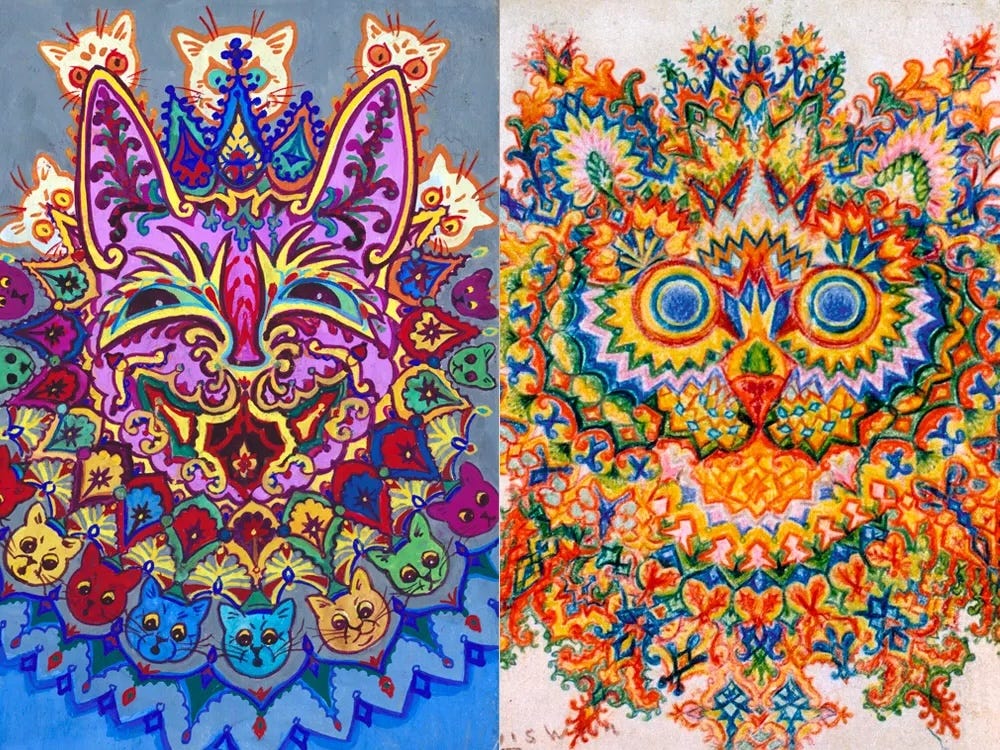
Louis Wain (1860-1939) | Painter
Watch: ‘The Electrical Life of Louis Wain’ | film directed by Will Sharpe
Read: ‘Louis Wain: The Man Who Drew Cats’ | biography by Rodney Dale
British artist Louis Wain spent his entire career painting one subject: cats. He began drawing them to comfort his young wife as she was dying of breast cancer, the family’s black and white kitten Peter her only solace. After her death, his portrayal of cats — anthropomorphic, wide-eyed, dressed in human clothes, playing cricket and attending tea parties — made him famous.
Then, in his late fifties, Wain’s behavior became erratic and paranoid, eventually violent, and he was committed to a psychiatric hospital in 1924, where he spent the rest of his life. He was diagnosed with schizophrenia, though the diagnosis has since been contested.
With time, his cats changed: illustrated with fractal patterns, their bodies dissolving into kaleidoscopic geometry. He continued painting his sole feline subject until his death.

HEAR
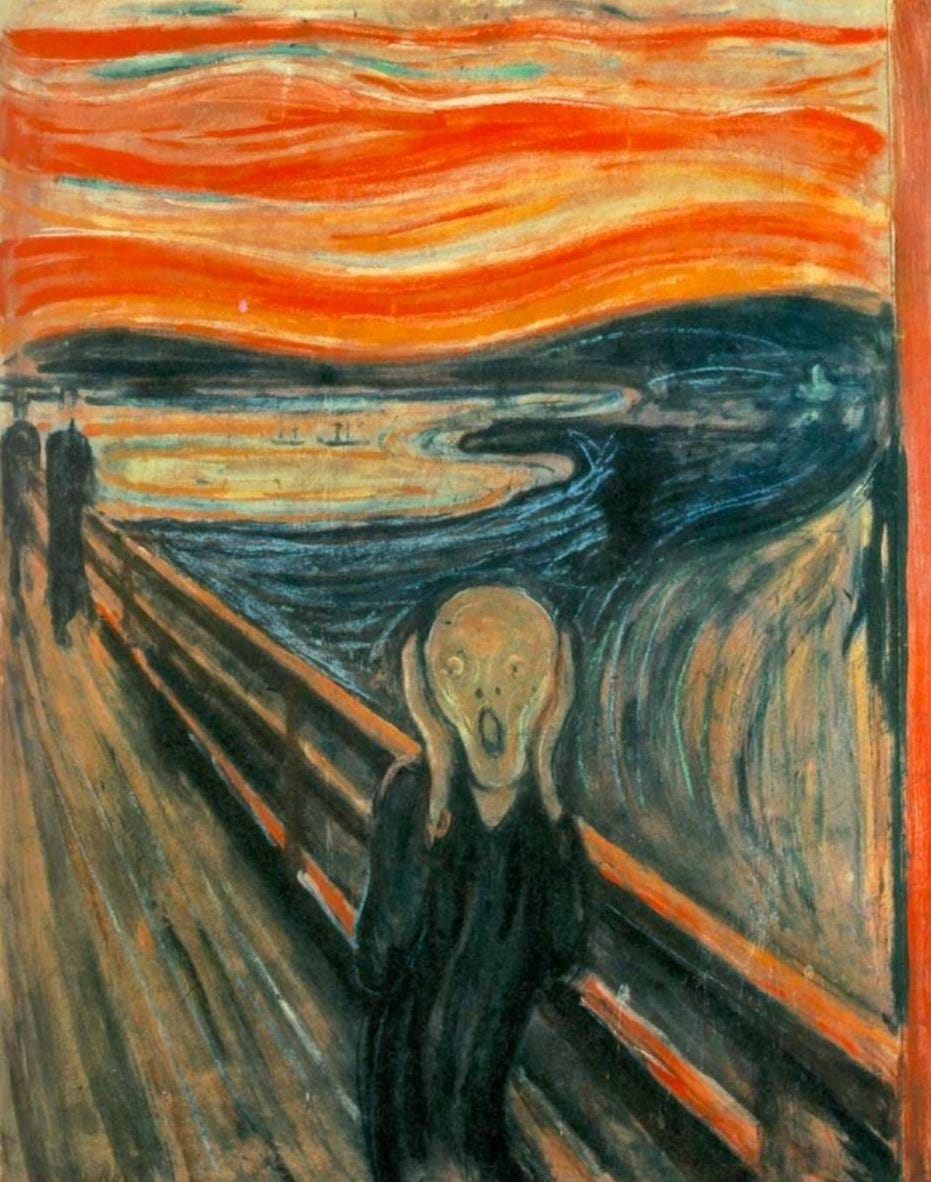
Edvard Munch (1863–1944) | Painter
Read: ‘Edvard Munch: Behind the Scream’ | book by Sue Prideaux
‘The Scream’ (1893) is one of the most recognizable paintings of the Expressionism era. It is also one of the most thoroughly documented cases of art born directly from psychosis.
Norwegian painter Edvard Munch recorded in his diary the experience that inspired his painting:
“I was walking along the road with two friends — the sun was setting — suddenly the sky turned blood red — I paused, feeling exhausted, and leaned on the fence — there was blood and tongues of fire above the blue-black fjord and the city — my friends walked on, and I stood there trembling with anxiety — and I sensed an infinite scream passing through nature.“
Munch had received a diagnosis of bipolar disorder with psychosis. In 1908, he was admitted to a psychiatric hospital for an intensification of auditory hallucinations, depression, and suicidal urges.
Yet, to him his mental condition was intrinsically linked to his art. He wrote: “My fear of life is necessary to me, as is my illness. Without anxiety and illness, I am a ship without a rudder. My sufferings are part of my self and my art. They are indistinguishable from me, and their destruction would destroy my art.“

SMELL
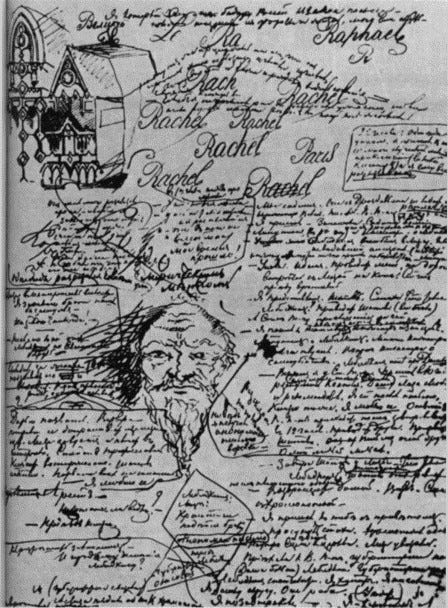
Fyodor Dostoevsky (1821–1881) | Philosopher & novelist
Read ‘The Sinner and the Saint’ by Kevin Birmingham
Fyodor Dostoevsky suffered from temporal lobe epilepsy — a condition so closely tied to his experience that neurologists now use the term “Dostoevsky’s epilepsy” to describe a variant characterized by ecstatic auras.
His seizures were often preceded by an ecstatic aura consisting of pleasant odors, lights, or other sensations. His friend Strakhov recorded his own words: “For several moments I would experience such joy as would be inconceivable in ordinary life — such joy that no one else could have any notion of. I would feel the most complete harmony in myself and in the whole world, and this feeling was so strong and sweet that for a few seconds of such bliss I would give ten or more years of my life, even my whole life perhaps.”
His experience inspired his work and he gave his condition to his fictional characters – such as Prince Myshkin in The Idiot, and to Kirillov in The Possessed.

TASTE
Giorgio de Chirico (1888–1978) | Painter
Read: ‘Memoirs of My Life’ | autobiography by Chirico
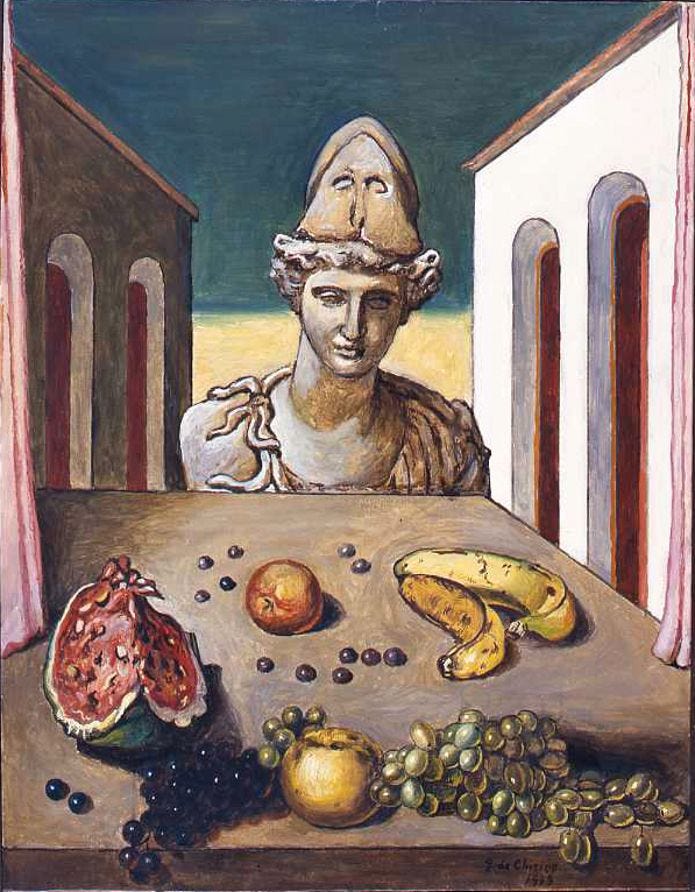
Giorgio de Chirico’s visual language originated from illness. Starting in 1906, while studying in Athens, de Chirico wrote of “frequent intestinal troubles“ that made him “feel tired, melancholic and discouraged.”
His abdominal complaints were accompanied by unpleasant gustatory hallucinations, anxiety and fear. In his own words: “In my mouth I could taste something like phenic acid.”
He captured this hallucinatory taste experience through his paintings of oversized artichokes, Ferrarese biscuits, bananas placed in empty piazzas like monuments.
The founding moment of his entire career came directly after a bout of illness: recovering in the Piazza Santa Croce in Florence, he wrote: “I had just come out of a long and painful intestinal illness, and I was in a nearly morbid state of sensitivity. The whole world, down to the marble of the buildings and the fountains, seemed to me to be convalescent... then I had the strange impression that I was looking at all these things for the first time.“

TOUCH
Yayoi Kusama (b.1929)| Visual Artist
Read ‘Infinity Net: The Autobiography of Yayoi Kusama’
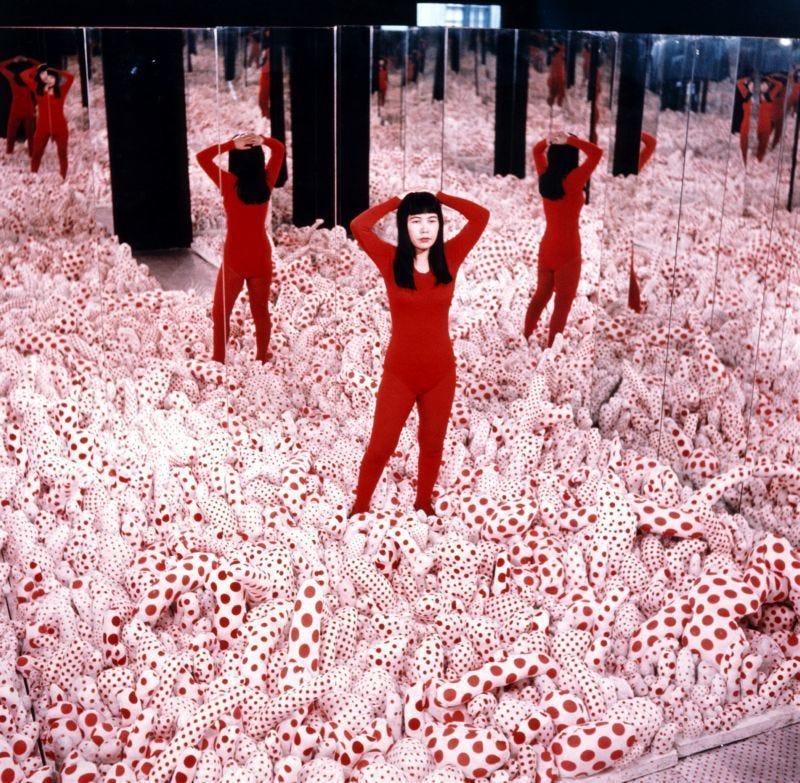
Kusama’s first hallucination was at the age ten when she saw dense fields of dots that came to life and consumed her surroundings, threatening to obliterate her. But her condition was not purely visual: her hallucinations crossed the boundary of skin — they migrated from surface into body.
She describes what happened while painting her Infinity Nets series in New York: “I would cover a canvas with nets, then continue painting them on the table, on the floor, and finally on my own body. As I repeated this process over and over again, the nets began to expand to infinity. I forgot about myself as they enveloped me, clinging to my arms and legs and clothes and filling the entire room. I woke one morning to find the nets I had painted the previous day stuck to the windows. Marveling at this, I went to touch them, and they crawled on and into the skin of my hands. My heart began racing. In the throes of a full-blown panic attack I called an ambulance.”
Her self-reported experience of touch was one of dissolution: the net pressed in, the body pressed out, and the boundary between the two was unreliable. In 1977, she admitted herself into a psychiatric facility in Tokyo, where she has lived ever since.
She describes her mental state: “I am deeply terrified by the obsessions crawling over my body, whether they come from within me or from outside. I fluctuate between feelings of reality and unreality. I, myself, delight in my obsessions.“

BALANCE
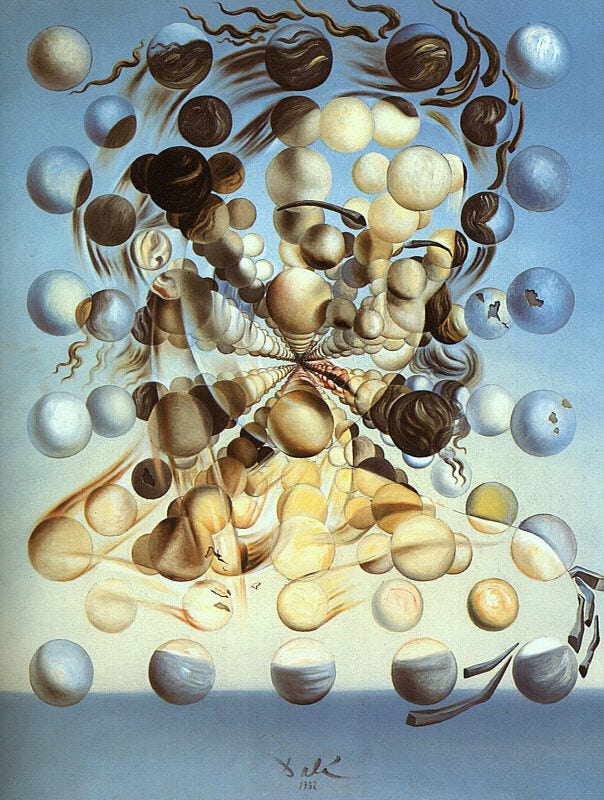
Salvador Dalí (1904–1989) | Visual Artist
Read: ‘The Secret Life of Salvador Dalí’ | autobiography
Watch ‘Dalí’ | documentary directed by David Pujol
Salvador Dalí did not wait for altered states to arrive — he engineered them.
Dalí suffered from paranoia and built his entire practice around it rather than treating it as something to be managed. He called this the “paranoiac-critical method” — a self-induced state of irrational association in which the paranoid mind, freed from logic, could perceive hidden connections and double meanings invisible to rational consciousness.
To do this, he relied on hypnagogia, the transitional state between wakefulness and sleep, which is characterized by hallucinations that are fundamentally vestibular in nature: falling sensations, floating, spinning, and body-location disorientation, the sense that the physical self has become untethered from space.
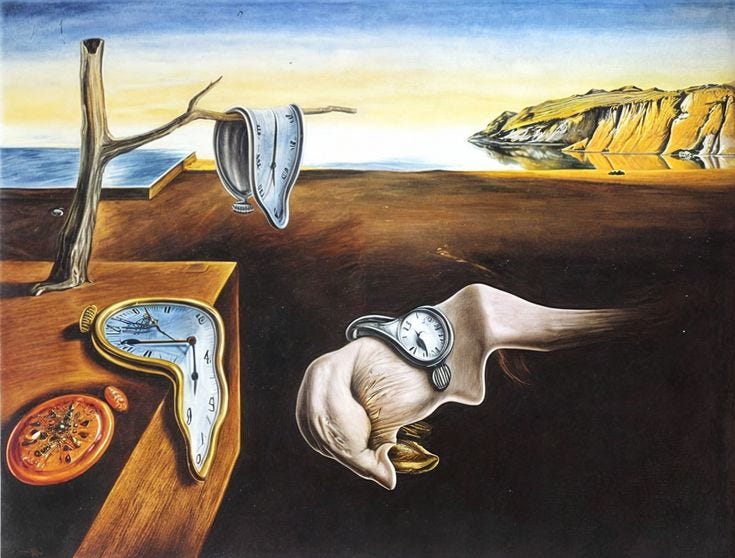
Dalí devised a precise method to induce this state: he would sit in a chair holding a large metal key above a bowl on the floor. As he drifted toward sleep, his grip would loosen, the key would fall, the clatter would wake him — and he would harvest whatever images had arrived in that suspended threshold before full consciousness returned.
He would then draw from this hypnagogic imagery: melting watches crawling with ants as depicted in ‘The Persistence of Memory.’

ENVISION
Egon Schiele (1890-1918) | Painter
Read: ‘Egon Schiele: The Midnight Soul of the Artist’ | book by Reinhard Steiner
Watch: ‘Egon Schiele: Death and the Maiden’ | biopic film directed by Dieter Berner
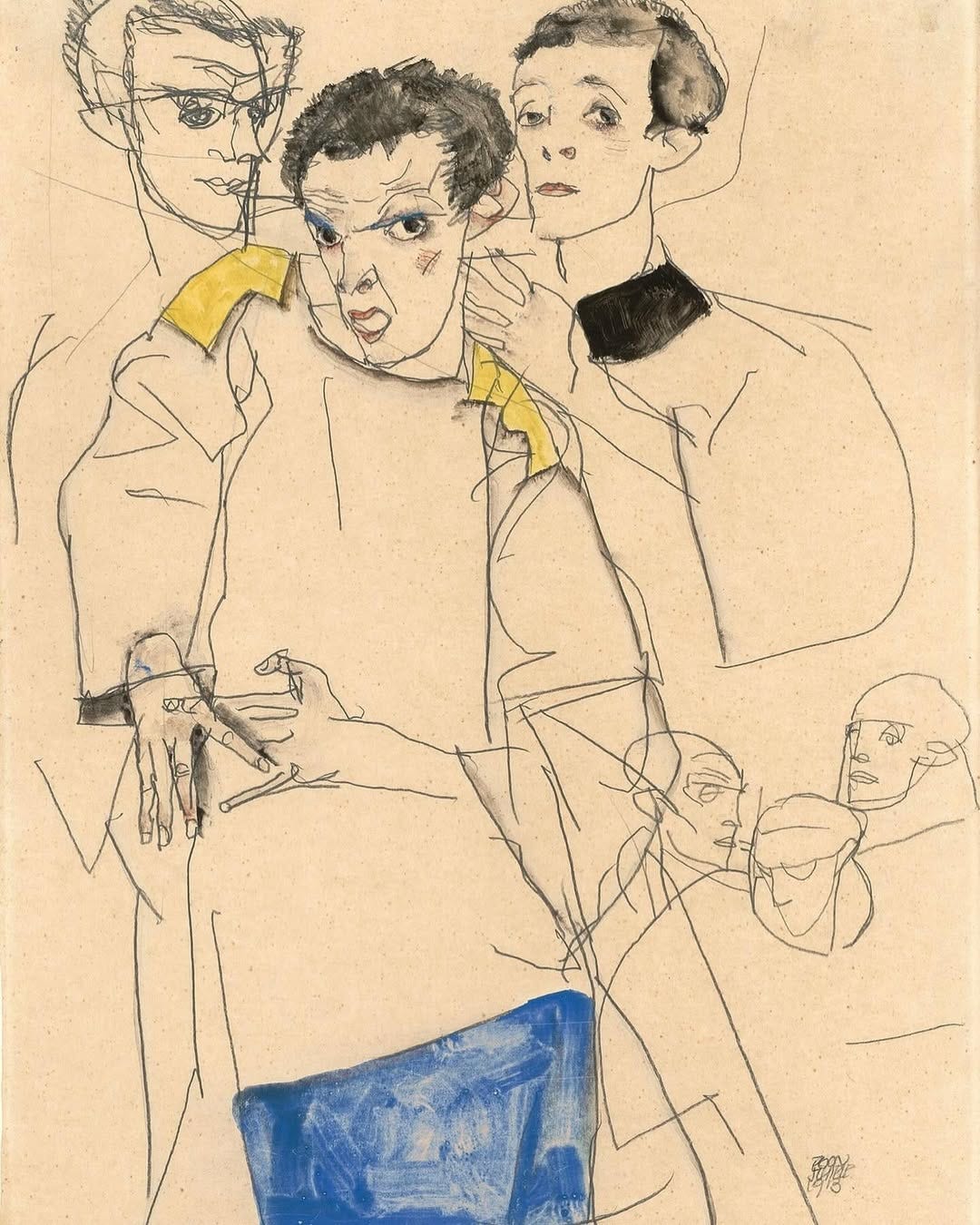
Egon Schiele died at 28, having produced over 300 paintings – most of which are self-portraits. He would often depict multiple simultaneous selves on the same canvas. Academic research has connected this obsession to heautoscopy — the neuropsychiatric phenomenon in which a person perceives a double of their own body in external space, creating ambiguity about where the self is actually located.
The phenomenon involves illusory multisensory self-reduplication, connecting to severe conditions involving the loss of self-identity in psychiatric disorders, and to Schiele’s unprecedented double and triple self-portraiture.
Proprioception (our seventh sense) — the ability of knowing where our body is in space — is precisely what heautoscopy disrupts: the body appears to exist in two locations simultaneously.
Schiele wrote: “Bodies have their own light which they consume to live: they burn, they are not lit from the outside.”
His self-portraits are attempts at cartography. The twisted limbs, the fractured poses, the figures that seem to observe themselves from a slight displacement, are the visual record of a self that could not locate itself with certainty in a single body.

“A symptom to be interpreted” Love.
This is a wonderful tour de force. I think we are approaching the moment when we return to the unconscious to regain our societal roots and find, or perhaps rediscover, the meaning in life that so many are seeking. Personally I am finding a lot of resonance in the work of Carl Jung.